WORKED EXAMPLES

Three ways to read visible reviews with a decision in mind.

These are worked examples, not client results. They describe a reproducible research question and an honest export boundary; they do not claim conversion lifts, revenue, time savings, or full review coverage.

WORKED EXAMPLE — NOT A CLIENT RESULT

Pre-launch product validation

Situation: Before sourcing a product, study one- and two-star feedback on a comparable product page for a concrete defect pattern.

What to scan: Set an exact one- or two-star filter only after the numeric confirmation succeeds. Choose a review-count target that keeps the sample reviewable.

Decision after reading: Use the visible complaints to decide whether to investigate a sourcing risk, revise product expectations, or stop the idea. Do not treat a limited scan as a complete product history.

Export used: A local Custom CSV or Markdown set can support manual notes. No client result, revenue claim, or time-saving metric is implied.
WORKED EXAMPLE — NOT A CLIENT RESULT

Ad-angle research

Situation: Study visible five-star feedback when you want to understand the phrases buyers use about a product experience.

What to scan: Use an exact five-star filter if its visible counts confirm. Photos only is optional and can naturally reduce the available sample.

Decision after reading: Read the original local reviews, choose a few phrases you can verify in context, and develop an angle only after your own review. Do not present buyer text as a guaranteed ad outcome.

Export used: Export Markdown or a Custom CSV only if it supports your own review process. This is a worked example, not a customer case study.

WORKED EXAMPLE — NOT A CLIENT RESULT

Shopify migration preparation

Situation: Prepare a product you already sell for a review-app import while documenting the fields the merchant still needs to supply.

What to scan: Collect a focused visible set, inspect Variant and photo URL availability, then open the relevant Export Center format.

Decision after reading: Supply a Shopify product handle or Product ID when the format asks for product matching. Treat Variant as a product option, not a Shopify SKU, and expect country or verified-purchase fields only when TikTok provides them.

Export used: Use a validated Shopify review-app CSV only after checking its format requirements. The merchant, not ReviewPort, supplies matching information.

REAL EXPORT CENTER CAPTURE

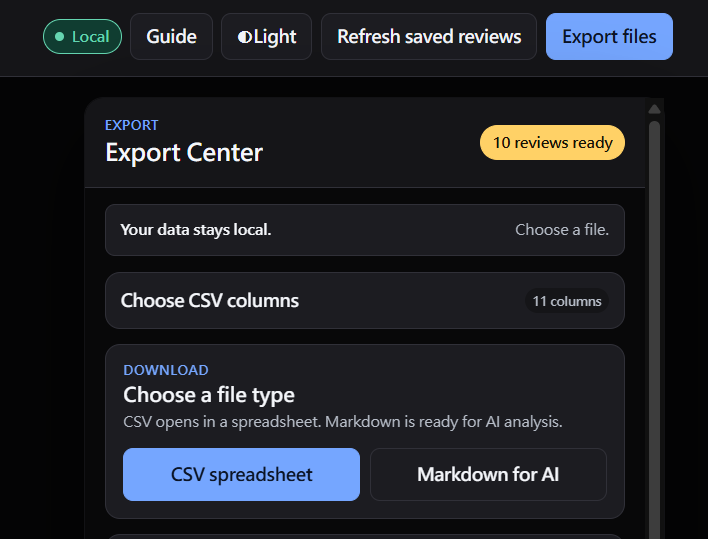
Choose a file type only after the local review set is ready.

This user-supplied capture shows ten reviews ready, a local-data reminder, eleven selectable CSV columns, and the visible CSV spreadsheet and Markdown for AI choices. It documents the local export chooser, not a completed Shopify import or a client result.

Real ReviewPort Export Center showing ten reviews ready, local-data reminder, eleven selectable CSV columns, CSV spreadsheet option, and Markdown for AI option

EVIDENCE BOUNDARY

Use the visible records, then verify the next system’s requirements.

The real capture above documents the local export chooser. This page still avoids fabricated buyer data, competitor brands, Shopify import outcomes, client results, or performance metrics. A merchant supplies product matching where a downstream format requires it.